

Multicolored Tourmaline — hardly any stone shows so many colors in a single crystal: green, pink, blue, and yellow, sometimes all at once. The colorful tourmaline variety elbaite is regarded in crystal healing as the stone of harmony and individuality — one of the few assigned to all seven chakras. In this guide, you’ll find everything about the supposed effects of multicolored tourmaline, its meaning, uses, proper care, and an authenticity check — concise, honest, and compiled by a specialist retailer.
Multicolored Tourmaline (Elbaite) — quick facts at a glance
| Mineral class | Ring silicate — tourmaline group, colorful variety elbaite (borosilicate) |
| Color | multicolored: green, pink, blue, yellow — often several colors in one crystal (“watermelon tourmaline”) |
| Hardness (Mohs) | 7 to 7.5 — hard and suitable for everyday wear |
| Crystal system | trigonal |
| Chakra | all seven chakras — the “wholeness stone” |
| Zodiac sign | Libra and Gemini (main) |
| Element | Earth |
| Special feature | pyro- and piezoelectric: becomes electrically charged when heated or rubbed |
| Suitable for gemstone water | Generally possible (hard) — especially popular with us as jewelry |
| Sunlight | Short exposure is unproblematic — protect vivid colors from intense, prolonged sun |
| Main sources | Brazil (Minas Gerais), Afghanistan, Pakistan, Madagascar, Mozambique, Nigeria, USA |
What is multicolored tourmaline? Mineralogy and origin
Multicolored tourmaline belongs to the tourmaline group, a family of complex boron ring silicates. The most colorful variety is called elbaite — named after the Italian island of Elba, where it was first scientifically described. Depending on the trace elements incorporated, the stone glows green, pink, blue, or yellow.
What’s fascinating: many crystals have grown in multiple colors — with color zones alternating along or across the crystal. The famous “watermelon tourmaline” has a pink core in a green outer layer.
With a Mohs hardness of 7 to 7.5, tourmaline is durable and ideal for jewelry. A real curiosity is its pyro- and piezoelectricity: when heated or subjected to pressure, the crystal becomes electrically charged and attracts dust particles — even the Dutch in the 18th century used it as an “ash puller” to clean their pipes.
The most important sources today are Brazil (Minas Gerais), Afghanistan, Pakistan, Madagascar, Mozambique, and Nigeria.
Meaning & history
The name tourmaline comes from Sinhala: “turamali” means “stone with mixed colors” — hardly a more fitting description exists. Around 1703, Dutch traders brought the first tourmalines from Ceylon (Sri Lanka) to Europe.
Throughout history, tourmaline was repeatedly mistaken for other gemstones — for example, the famous “ruby” in the Bohemian St. Wenceslas Crown is actually a red tourmaline. Only modern mineralogy decoded the independent tourmaline family.
In crystal healing, multicolored tourmaline is considered the stone of wholeness: it is said to promote inner harmony, connect all aspects of being — body, soul, and spirit — and at the same time strengthen one’s individuality. A stone that does not smooth out diversity, but celebrates it.
Supposed effect of multicolored tourmaline on the psyche
When someone asks us for a stone for inner harmony and the courage to embrace one’s own versatility, multicolored tourmaline is our first recommendation. In crystal healing, it is said to have the following effects:
- Inner harmony: The core of its tradition — multicolored tourmaline is said to bring body, soul, and spirit into balance.
- Individuality: Said to strengthen one’s own personality and encourage showing all facets of oneself.
- Finding one’s place: Said to help you take your place in life — professionally and privately.
- Creativity: Its variety of colors is seen as an impulse for imagination, inventiveness, and creative work.
- Balance: Said to smooth mood swings and reconcile opposites — the diplomat among stones.
- Openness: Said to make you curious about new things without losing your center.
Multicolored tourmaline is therefore especially suitable for people with many facets and interests — and for phases in which it is about reconciling your own sides and finding your place.
Supposed effect of multicolored tourmaline on the body
In traditional crystal healing, the following physical effects are attributed to multicolored tourmaline — these statements come from traditional descriptions and are not a substitute for medical diagnosis or treatment.
- Body fluids: In traditional lore, multicolored tourmaline is said to help harmonize the body’s fluid balance.
- Blood vessels: In crystal healing, it is associated with a balancing effect on the blood vessels.
- Connective tissue & skin: Traditionally assigned to connective tissue and skin.
- Nerves & regeneration: Considered a stone that is said to calm the nervous system and support regeneration.
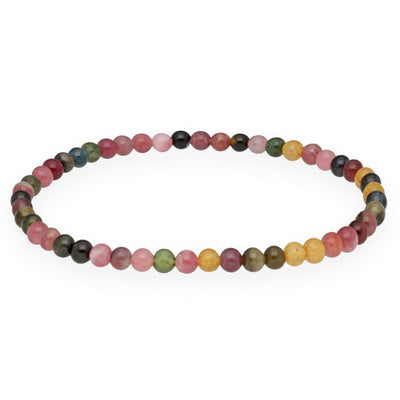
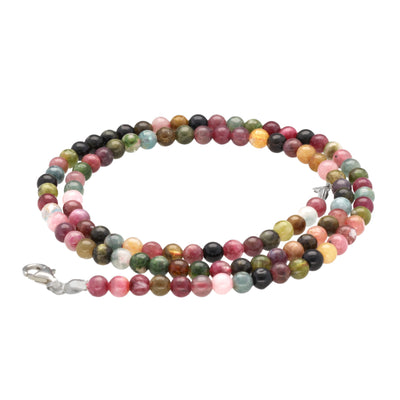
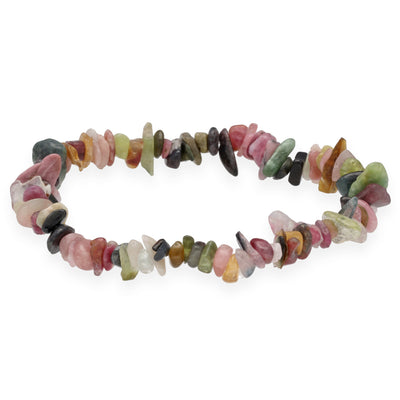
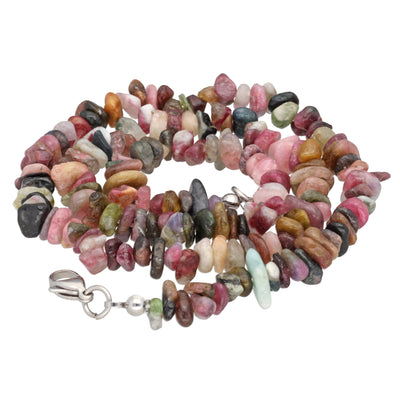
The color variety unfolds most beautifully directly on the body: as a bracelet, necklace, or palm stone — every multicolored tourmaline is a small one-of-a-kind color piece.
Multicolored tourmaline and the chakras
Multicolored tourmaline is one of the few stones assigned to all seven main chakras — its variety of colors reflects the entire chakra spectrum: red and brown for the root, green and pink for the heart, blue for throat and brow.
In chakra work, it is therefore considered a “wholeness stone”: it is said to connect the energy centers, balance blockages between them, and harmonize the flow of energy as a whole.
In practice, multicolored tourmaline is worn as a bracelet or necklace — or placed during meditation wherever balance is currently needed.
Multicolored Tourmaline & the 7 main chakras
Multicolored tourmaline is the wholeness stone among healing stones — it is assigned to all seven chakras and is said to harmonize their energy flow as a whole.
Multicolored tourmaline and the zodiac signs
Astrologically, multicolored tourmaline is considered the main stone for Libra and Gemini. For Libra, which seeks harmony, it is said to help find balance not only externally but also internally. For versatile Geminis, it is said to provide support in living out their many interests as a strength.
As a stone of harmony and individuality, multicolored tourmaline suits every zodiac sign — especially people who unite many facets within themselves.
Using multicolored tourmaline in everyday life
1. As a bracelet — your daily companion for harmony
A bracelet made of multicolored tourmaline is the classic use — the variety of colors accompanies you visibly throughout the day.
2. In chakra meditation
Placed on the chakra that currently needs balance as a wholeness stone — or let it move in your hand over all centers.
3. During creative work
A multicolored tourmaline on the desk is said to stimulate imagination and the flow of ideas.
4. During periods of change
Traditionally used when it is time to find your place anew — at work, in relationships, in life.
5. As a necklace at heart level
Worn at heart level, it is said to reconcile opposites and strengthen inner balance.
Tourmaline, multicolored bei Lebensquelle Plus
Echte Naturqualität — versandfertig aus Waldbröl, geprüfter Fachhandel.
Cleaning and recharging multicolored tourmaline
Clean & recharge multicolored tourmaline
Multicolored tourmaline is hard and uncomplicated — regular, simple care is enough.
Discharge
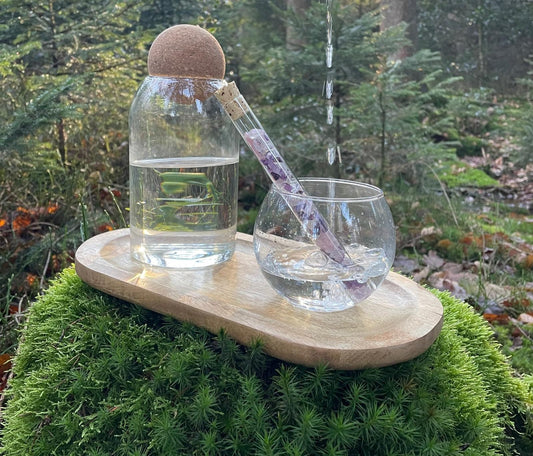
Discharge in a bowl with hematite tumbled stones — gentle and reliable.
Alternatively, rinse briefly under lukewarm running water and dry it.
Recharge
Recharge in moonlight or on an amethyst cluster.
The amethyst cluster is considered the classic “charging place” for tourmalines of all colors.
Recognizing authenticity
Multicolored tourmaline is sometimes imitated by colored glass or synthetic stones. These features help:
- Natural color zoning: genuine crystals show irregular color zones and transitions — perfectly even coloration is suspicious.
- Pleochroism: tourmaline changes color depth depending on the viewing angle (strongly dichroic) — glass shows the same color from every direction.
- Hardness: with 7–7.5, tourmaline scratches glass effortlessly — soft imitations are ruled out.
- Electrostatics: the curiosity: when rubbed vigorously or heated, genuine tourmaline attracts small dust or paper particles.
- Inclusions: fine natural inclusions and growth lines are normal — sterile clarity with bubbles points to glass.
Genuine multicolored tourmaline lives from irregular, natural color zones and changing color depth. At Lebensquelle Plus, our tourmaline comes in verified natural quality — no dyes.
Combining multicolored tourmaline with other stones
- Multicolored tourmaline + Black Tourmaline — the family combo — protection and grounding meet color variety and harmony.
- Multicolored tourmaline + Clear Quartz — Clear Quartz clarifies and amplifies the harmonizing effect.
- Multicolored tourmaline + Rose Quartz — harmony meets warmth of heart — a gentle combo for relationships.
- Multicolored tourmaline + Aventurine — serenity and lightness — good against everyday stress.
- Multicolored tourmaline + Fluorite — two colorful stones with structure — creativity and mental order as a team.
Frequently asked questions about the effects of multicolored tourmaline
01 What does multicolored tourmaline do? +
In crystal healing, multicolored tourmaline is considered a stone of harmony and individuality. It is said to connect body, soul, and spirit, strengthen one’s personality, stimulate creativity, and traditionally harmonize the body’s fluid balance as well as affect blood vessels, connective tissue, and skin.
02 What is the difference between multicolored and black tourmaline? +
Both belong to the tourmaline group. Black tourmaline (schorl) is iron-rich, opaque black, and is considered a protection and grounding stone. Multicolored tourmaline (elbaite) is the colorful, often translucent variety and stands for harmony, diversity, and individuality.
03 What is watermelon tourmaline? +
A multicolored elbaite with a pink core and green outer layer — in cross-section it looks like a slice of watermelon. It is considered a particularly sought-after collector’s variety of multicolored tourmaline.
04 Which zodiac sign is multicolored tourmaline for? +
Multicolored tourmaline is mainly assigned to Libra and Gemini — Libra for inner balance, Gemini for versatility. As a harmony stone, however, it suits every zodiac sign.
05 Which chakra is multicolored tourmaline assigned to? +
All seven — that is its special feature. Because of its variety of colors, multicolored tourmaline is considered a wholeness stone that is said to connect the energy centers and harmonize the energy flow as a whole.
06 Can multicolored tourmaline go in water? +
Yes — with a hardness of 7–7.5, tourmaline is robust and tolerates water without issue. A brief rinse for cleaning is ideal; as with all stones, we advise against long saltwater baths.
07 How do I care for multicolored tourmaline properly? +
Discharge: in hematite tumbled stones or briefly under running water. Recharge: in moonlight or on an amethyst cluster. Protect vivid colors from intense, prolonged sun. Complete guide: see our care guide.
08 How do I recognize genuine multicolored tourmaline? +
Genuine tourmaline shows irregular color zones, changes color depth depending on the viewing angle, and scratches glass. Curiously, when rubbed or heated it becomes electrically charged and attracts dust particles — glass imitations cannot do that.
09 Is multicolored tourmaline suitable as a gift? +
Very much so — it is the perfect gift for versatile people to whom you wish harmony and the courage to be themselves. And visually, every stone is a small burst of color.
Conclusion
Multicolored tourmaline — the rainbow among healing stones. In crystal healing, it stands for harmony, individuality, and the art of living out all one’s facets. Anyone looking for their place or wanting to celebrate their versatility will find a colorful, durable companion in it.
In our multicolored tourmaline range ↗ you’ll find bracelets, necklaces, and tumbled stones made from genuine natural quality — ready to ship from Waldbröl or directly on site in our store in Nümbrecht.
Important note: The effects described here come from traditional crystal healing and are not scientifically proven. They do not replace medical diagnosis or treatment. If you have health concerns, please consult a doctor.
Further gemstone guides
- Black Tourmaline (Schorl) effect — protection & grounding
- Fluorite effect — meaning, use & care
- Clean and recharge gemstones — the easy way
- Rose Quartz effect — meaning, use & cleansing
- Aventurine effect — meaning, use & cleansing
- View all multicolored tourmaline products