



If you hold Charoit in your hand for the first time, you won’t forget it quickly: silky swirls run through lilac, violet, and deep dark purple, as if smoke had solidified in the stone. Jewelry-grade Charoit comes almost exclusively from a single area in Siberia — making it one of the rarest purple gemstones of all. It is said to accompany change, inner calm, and intuitive perception. Many choose it as a palm stone, jewelry stone, or quiet companion for mindful breaks. Here you’ll learn how to recognize, use, and properly care for Charoit because of its medium hardness — compiled by a specialist retailer.
Charoite — quick profile at a glance
| Mineral class | Silicates and germanates, chain silicate |
| Color | Lilac, violet to dark violet, often with white and black inclusions |
| Hardness (Mohs) | 5–6 |
| Crystal system | Monoclinic |
| Chakra | Crown chakra, third eye chakra |
| Zodiac sign | Scorpio, Sagittarius; additionally Aquarius |
| Element | Ether |
| Special feature | Rare, fibrously swirled structure with a silky sheen |
| Suitable for gemstone water | No — water contact only briefly for cleaning |
| Sunlight | Tolerates short exposure; avoid intense direct sun |
| Main sources | Murun Massif in eastern Siberia, Russia |
What is Charoit? Mineralogy and origin
Charoit is a water-containing, complex potassium-calcium silicate from the chain silicate group. Its formula is approximately given as (K,Sr,Ba,Mn)15–16(Ca,Na)32[Si70(O,OH)180](OH,F)4 · nH2O. It crystallizes monoclinically and reaches a Mohs hardness of 5–6.
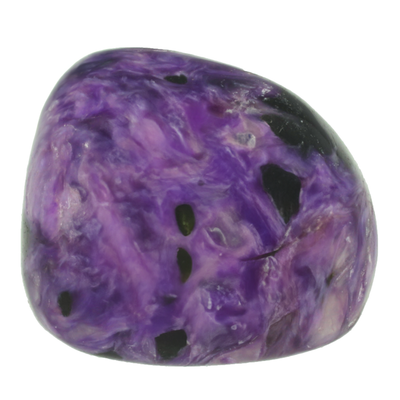
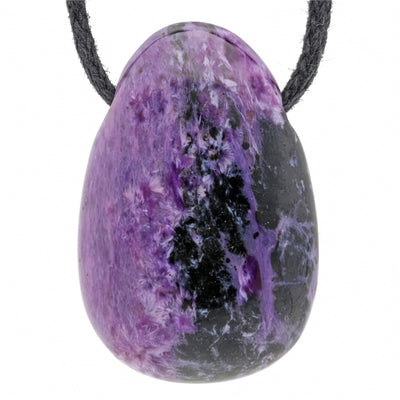
Characteristic are lilac to intensely violet sections with fibrous, cloudy, or swirling structures. The silky sheen is created by parallel mineral fibers. Black aegirine, yellowish-brown tinaksite, as well as light feldspar or cancrinite components make each piece unique.
Because of its medium hardness, Charoit is sensitive to scratches and impacts; acids, harsh cleaners, and intense direct sunlight are off-limits. Jewelry-grade material comes almost exclusively from the Murun Massif in eastern Siberia, Russia.
Meaning & history
Charoit owes its name to the Chara River in Siberia, which runs near the discovery area. The name therefore refers directly to its remote home in the Murun Massif.
The first finds were examined in the 20th century, and it was officially described as a distinct mineral only in 1978 — so there is no ancient tradition. Since then, Charoit has mainly been processed into cabochons, jewelry, tumbled stones, and decorative objects.
In modern crystal healing, Charoit is considered a stone of transformation. It is said to provide impulses for composure, acceptance, and intuitive clarity — interpretations that are not scientifically proven.
Purported effect of Charoit on the psyche
In our specialist shop, customers mainly reach for Charoit during phases of reorientation; in crystal healing, the following effects are attributed to it:
- Embracing change: Charoit is said to help face change more calmly and allow new paths.
- Inner calm: Its gentle violet radiance is said to help you mentally step back.
- Strengthening intuition: The stone is said to encourage trust in one’s own perception and inner voice.
- Courage & confidence: In unfamiliar situations, Charoit is said to accompany courage and a confident basic attitude.
- Organizing thoughts: It is said to slow the mental carousel and make priorities clearer.
- Letting go of the old: Charoit is said to help recognize outdated thought patterns and leave them behind more easily.
Charoit suits anyone who is currently at a threshold — before a decision, in a new beginning, or with the wish for more calm and inner alignment.
Purported effect of Charoit on the body
In traditional crystal healing, the following physical effects are attributed to Charoit — these statements come from transmitted descriptions and are not a substitute for medical diagnosis or treatment.
- Sleep & rest: Traditionally, Charoit accompanies relaxed evening rituals as a calming anchor.
- Well-being: In crystal healing, its gentle radiance is said to accompany general well-being.
- Tension: Its use as a palm stone is traditionally passed down for when tension builds up in everyday life.
- Recovery: Traditionally, Charoit is placed during conscious rest breaks or quiet meditations.
- Body awareness: In folk healing, it is considered a companion for mindful awareness of one’s own needs.
- Switching off: Its use as a calm visual focal point before bedtime is traditionally passed down.
Charoit is not suitable for gemstone water prepared by direct contact. The complex, fibrous mineral should only briefly come into contact with lukewarm water and then be dried carefully. If you still want to include it in a water ritual, choose the indirect method — the stone remains outside the water. Suitable pieces can be found in the Charoit range.

Charoit and the chakras
Charoit is primarily associated with the crown chakra. In spiritual traditions, this energy center stands for consciousness, recognizing larger connections, and connection to one’s own inner alignment.
For meditation, you can place Charoit above your head or hold it comfortably in your hand. It is said to encourage mental spaciousness and a calmer view of change.
Additionally, the third eye chakra is considered its center. Here, Charoit is said to accompany intuition, imagination, and conscious perception. Many find short, regular applications more pleasant than long placements.
Charoit & the 7 main chakras
Its deep violet connects Charoit primarily with the crown chakra and third eye chakra.
Charoit and the zodiac signs
Charoit is primarily associated with Scorpio. Its purported transformative power is said to suit the intense, profound nature of this sign and help one consciously accept change.
Sagittarius and Aquarius are considered secondary signs, as the stone is said to accompany openness, foresight, and intuitive orientation. But Charoit suits anyone who wants to shape change more calmly and give more space to their inner perception.
Using Charoit in everyday life
1. As a bracelet — in everyday life
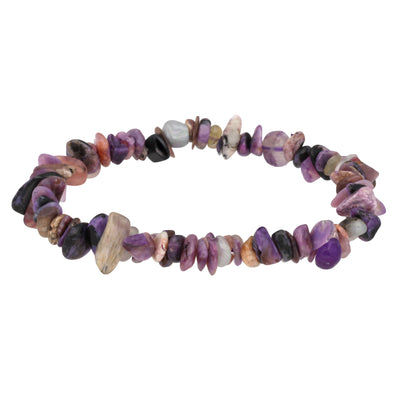
On the wrist, Charoit is always close and visible. Before sports, housework, and water contact, it’s better to take off the bracelet — this keeps the stone protected from impacts and scratches.
2. As a palm stone — on the go
A polished Charoit in your trouser pocket is a quiet anchor for short breathing breaks. Keep it in a fabric pouch, separate from keys and harder stones.
3. During meditation — focused
Hold Charoit in your hand or place it a little above your head. Five to ten calm minutes are enough for a mindful ritual.
4. At your resting place — visible
Next to your reading chair or meditation spot, Charoit becomes a calm eye-catcher. Avoid windowsills with intense direct sunlight.
5. As a pendant — close to the body
A Charoit pendant accompanies you effortlessly throughout the day. Make sure the setting protects the stone from hard edges and impacts.
Charoite at Lebensquelle Plus
Genuine natural quality — ready to ship from Waldbröl, a trusted specialist shop.
Cleaning and charging Charoit
Clean & charge Charoit
With a Mohs hardness of 5–6, Charoit appreciates short, gentle care without aggressive agents.
Discharge
Hold Charoit briefly under lukewarm water and then dry it completely with a soft cloth. No soaking, no strong temperature changes.
Alternatively, place it in a bowl with hematite tumbled stones for a few hours — completely without water.
Charge
Place Charoit in gentle moonlight overnight — a protected spot indoors is sufficient.
Alternatively, it may rest on or beside an amethyst druse for a few hours.
⚠️ Charoit has a Mohs hardness of 5–6: protect it from scratches, impacts, and prolonged water contact. Intense direct sunlight can affect the color. Avoid acids and harsh cleaners.
Recognizing authenticity
Thanks to its unmistakable structure and its tightly limited origin, genuine Charoit is fairly easy to recognize.
- Color: Natural Charoit usually shows lilac, violet, and dark violet in several shades — rarely a completely uniform color.
- Pattern: Typical are fibrous swirls, cloudy bands, and a silky sheen that seems to move as the stone is turned in the light.
- Inclusions: White, gray, black, or occasionally yellowish-brown mineral components are natural and not a quality defect.
- Origin: Jewelry-grade Charoit comes almost exclusively from the Murun Massif in eastern Siberia, Russia.
- Imitations: Uniformly violet stones without a fibrous structure may be dyed foreign minerals or synthetic material.
If the color looks unusually bright and completely homogeneous, it’s worth taking a second look. At Lebensquelle Plus, you’ll receive hand-selected natural quality from our gemstone specialist shop.
Combining Charoit with other stones
- Charoit + Amethyst — The violet duo is said to support calm, mental clarity, and a mindful meditation practice.
- Charoit + Clear Quartz — Clear quartz is said to amplify Charoit’s alignment and sharpen focus in ritual work.
- Charoit + Smoky Quartz — This combination is said to connect change with grounding and provide support in restless phases.
- Charoit + Lepidolite — Both stones are said to have a gentle, calming quality — ideal for conscious rest periods.
- Charoit + Moonstone — The duo is said to promote intuition and openness and accompany new phases of life more calmly.
Frequently asked questions about the effect of Charoit
01 What does Charoit do? +
Charoit is said to accompany change, inner calm, and intuitive perception. In crystal healing, it is considered a stone for reorientation and conscious letting go; these interpretations are not scientifically proven.
02 Can Charoit go in water? +
For cleaning, Charoit may briefly go under lukewarm water. Soaking and gemstone water prepared by direct contact are not recommended because of its complex, fibrous structure — use the indirect method instead.
03 How do I care for Charoit properly? +
Clean Charoit briefly with lukewarm water and a soft cloth, then dry it carefully. You can charge it in moonlight or on an amethyst druse; avoid intense direct sunlight, acids, and harsh cleaners. More on this under Clean and charge gemstones.
04 Which zodiac sign is Charoit for? +
Charoit is primarily associated with Scorpio. Sagittarius and Aquarius are considered secondary signs — but you can choose it regardless of your zodiac sign.
05 Which stones go well with Charoit? +
Good partners are Amethyst, Clear Quartz, Smoky Quartz, Lepidolite, and Moonstone. Depending on the choice, the duo is said to emphasize calm, clarity, grounding, or intuition.
06 Why is Charoit so rare? +
Jewelry-grade Charoit comes almost exclusively from a very limited area in the Murun Massif in eastern Siberia. This small occurrence and its striking violet fibrous structure make it a true mineralogical rarity.
07 Which chakra is Charoit assigned to? +
Charoit is primarily assigned to the crown chakra and additionally to the third eye chakra. There, it is said to accompany mental spaciousness, intuition, and a calm inner alignment.
08 How do I recognize genuine Charoit? +
Genuine Charoit shows violet color gradations, fibrous swirls, and a silky sheen. White, black, or yellowish-brown accompanying minerals are natural; a brightly uniform color should be viewed critically.
Conclusion
Charoit is a rare violet chain silicate with a silky fibrous pattern — each piece a unique specimen from Siberia. As a stone of transformation, it is said to accompany composure, intuition, and conscious reorientation. Its Mohs hardness of 5–6 calls for gentle cleaning and protection from impacts, scratches, and intense direct sunlight.
Discover selected tumbled stones, jewelry, and collector’s pieces in our Charoit range ↗ — ready to ship from Waldbröl or directly on site in our store in Nümbrecht.
Important note: The effects described here come from traditional crystal healing and are not scientifically proven. They do not replace medical diagnosis or treatment. If you have health concerns, please consult a doctor.
Further gemstone guides
- Clear Quartz effect — meaning, use & cleansing
- Amethyst effect — meaning, use & cleansing
- Clean and charge gemstones — the easy way
- Amethyst effect: meaning, use & care
- Lepidolite effect: meaning, use & care
- View all Charoit products
