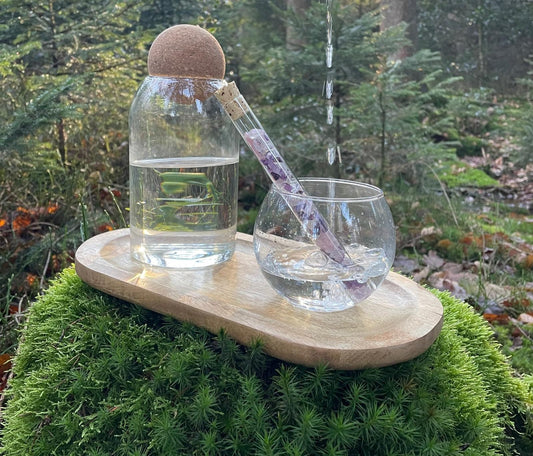


Angelite — soft sky blue with fine white veins, named after the angels. Mineralogically, it is a blue anhydrite, discovered only in 1987 in Peru. In crystal healing, Angelite is considered the stone of inner peace and honest communication. In this guide, you’ll find everything about the supposed effects of Angelite, its meaning, uses, proper care — including the most important rule: Angelite must not go in water — and an authenticity check. Brief, honest, and compiled by a specialist retailer.
Angelite — quick facts at a glance
| Mineral class | Sulfate — blue anhydrite (CaSO4, anhydrous calcium sulfate) |
| Color | sky blue to blue-gray, often with fine white veins |
| Hardness (Mohs) | 3 to 3.5 — soft and delicate |
| Crystal system | orthorhombic |
| Chakra | Throat chakra (Vishuddha) |
| Zodiac sign | Aquarius (main), Pisces (secondary stone) |
| Element | Air |
| Special feature | “Anhydrite” literally means “without water” — when exposed to water, the stone absorbs it and slowly transforms into gypsum |
| Suitable for gemstone water | No — never! Angelite is sensitive to water and changes when it comes into contact with it |
| Sunlight | Avoid — the delicate color can fade; charge in moonlight |
| Main sources | Peru (trade quality “Angelite”); anhydrite also in Mexico and Germany |
What is Angelite? Mineralogy and origin
Angelite is the trade name for blue anhydrite — an anhydrous calcium sulfate. Its name says it all: Anhydrite comes from the Greek “an-hydor” and means “without water”. That is exactly where its sensitivity lies: with prolonged contact with water, the stone absorbs water into its structure and slowly transforms into gypsum — the surface becomes dull and rough.
With a Mohs hardness of only 3 to 3.5, Angelite is one of the softer stones. Its color is unmistakable: a delicate, powdery sky blue, often crossed by fine white veins, with a silky matte sheen.
The beautiful blue jewelry quality comes almost exclusively from Peru — the stone was discovered there in 1987 and received its heavenly trade name.
Meaning & history
The name Angelite is derived from the Latin angelus = angel — because of its sky-blue color, it has been called the “stone of the angels” since its discovery.
Angelite is a young stone in crystal healing: first discovered in Peru in 1987, it quickly earned a firm place — as a gentle companion for calm, comfort, and conscious communication. Many associate it with a feeling of security and a “line to above.”
In modern crystal healing, Angelite is considered the stone of inner peace and contentment — and a throat chakra stone for the honest, mindful expression of one’s own thoughts.
Supposed effect of Angelite on the psyche
When someone asks us for a stone for calm, comfort, or mindful communication, Angelite is one of the gentlest recommendations. In crystal healing, the following effects are attributed to it:
- Inner peace & contentment: The core of its tradition — Angelite is said to calm and give a feeling of peace.
- Honest communication: As a throat chakra stone, it is said to support the conscious, honest expression of one’s own thoughts.
- Letting go of stress: May help reduce tension and take everyday life more gently.
- Developing trust: Is said to promote basic trust and confidence — in oneself and in life.
- Comfort & security: Considered a comforting stone in difficult times — as gentle as its sky blue color.
- Mindfulness: Is said to help you listen more consciously and respond with greater calm.
Angelite is therefore especially suitable for phases in which restlessness, stress, or the need for comfort and honest words are an issue — and for people who want to speak more gently with themselves and others.
Supposed effect of Angelite on the body
In traditional crystal healing, Angelite is attributed the following physical effects — these statements come from traditional descriptions and are not a substitute for medical diagnosis or treatment.
- Water retention: Fitting its name (“without water”), Angelite is said to help reduce water retention.
- Throat & voice: As a throat chakra stone, traditionally associated with the throat and laryngeal area.
- Relaxation: Linked to easing stress-related tension.
- Restful sleep: Traditionally used as a gentle companion for winding down and falling asleep.
Important: Angelite should never go in water — not even for gemstone water. Instead, wear it as a pendant or palm stone directly on the body — ideally at throat level.
Angelite and the chakras
In chakra teachings, Angelite is assigned to the throat chakra (Vishuddha) — the energy center for communication, self-expression, and truthfulness. Its soft sky blue is the classic color of this energy.
Unlike stronger throat chakra stones, Angelite stands for the quiet tones: mindful listening, honest yet gentle speaking, words that connect rather than hurt.
In practice, Angelite is placed on the throat during meditation or worn as a pendant. It is said to calm there and encourage honest, kind expression.
Angelite & the 7 main chakras
Angelite is a gentle throat chakra stone — it is said to calm and encourage the honest, mindful expression of one’s own thoughts.
Angelite and the zodiac signs
Astrologically, Angelite is considered the main stone for Aquarius — the freedom-loving air sign. It is said to help calm their many thoughts and communicate ideals with composure.
As a secondary stone, it is for Pisces — the most sensitive sign of the zodiac. The gentle “stone of the angels” is said to give them comfort and a calm protective space.
As a stone of calm and trust, Angelite suits every zodiac sign, especially people seeking comfort, composure, or a gentler tone.
Using Angelite in everyday life
1. As a pendant on the neck — the gentle companion
An Angelite pendant at throat level is the classic use — directly at the throat chakra, it is said to calm and encourage mindful expression.
2. In the hand — during stress
Hold an Angelite palm stone firmly when your thoughts are racing — its powdery-soft feel is immediately calming for many people.
3. In meditation — for inner peace
Placed on the throat or held in the hand, Angelite is said to bring calm and allow trust to grow.
4. Before difficult conversations
Traditionally used to stay calm, honest, and kind in sensitive conversations.
5. On the bedside table — to switch off
An Angelite by the bed is said to help you let go of the day in the evening and fall asleep peacefully.
Angelite bei Lebensquelle Plus
Echte Naturqualität — versandfertig aus Waldbröl, geprüfter Fachhandel.
Cleaning and charging Angelite
Clean & charge Angelite
Angelite is soft (hardness 3–3.5) and sensitive to water — care is simple, but the water rule is mandatory.
Discharge
Discharge in a bowl with hematite tumbled stones — the safe method for Angelite.
Never discharge under water — contact with water damages the stone.
Charge
Charge in moonlight or on clear quartz chips — do not place in the sun.
A bowl with clear quartz chips keeps Angelite fresh for a long time.
⚠️ Important: Angelite is sensitive to water — never place it in water, no gemstone water, no rinsing! Anhydrite absorbs water and slowly transforms into gypsum; the surface becomes dull. Clean only dry with a soft cloth. Also avoid sun, salt, and ultrasound.
Recognizing authenticity
Angelite is occasionally imitated by dyed magnesite or howlite. These features help:
- Powdery sky blue: genuine Angelite has a soft, slightly grayish blue tone with a silky matte sheen — bright “turquoise blue” suggests dyeing.
- Fine white veins: delicate, irregular white veins are typical; dyed howlite, by contrast, usually shows gray, spiderweb-like veins.
- Softness: with a hardness of 3–3.5, Angelite is soft — it can be scratched (in an inconspicuous spot) with a copper coin.
- Weight: Angelite feels pleasantly heavy for its size (density ~2.9–3.0) — noticeably lighter beads suggest an imitation.
- Color rub test: with dyed material, a damp white cloth (only if imitation is suspected!) often shows color traces — genuine Angelite does not rub off.
Genuine Angelite is powdery sky blue, silky matte, and pleasantly heavy. At Lebensquelle Plus, Angelite comes from tested natural quality from Peru — no dyed imitation.
Combining Angelite with other stones
- Angelite + Chalcedony — two gentle communication stones — for calm, friendly words.
- Angelite + Larimar — double sky blue — composure and clear expression as a team.
- Angelite + Clear Quartz — Clear Quartz clarifies and amplifies the calming effect.
- Angelite + Amethyst — calm meets relaxation — ideal for switching off in the evening.
- Angelite + Rose Quartz — gentleness meets warmth of heart — the feel-good combo.
Frequently asked questions about the effects of Angelite
01 What does Angelite do? +
In crystal healing, Angelite is considered a stone of inner peace and contentment. It is said to support conscious, honest communication, help let go of stress, promote trust, and have a supportive effect in reducing water retention.
02 Can Angelite go in water? +
No — never! Angelite is blue anhydrite (“without water”): when it comes into contact with water, it absorbs it and slowly transforms into gypsum, and the surface becomes dull and rough. No gemstone water, no rinsing — clean only dry with a soft cloth and discharge over hematite.
03 What kind of stone is Angelite? +
Angelite is the trade name for blue anhydrite, an anhydrous calcium sulfate with a hardness of 3–3.5. The beautiful sky-blue jewelry quality was discovered in Peru in 1987 — hence its name “stone of the angels” (Latin angelus).
04 Which zodiac sign is Angelite for? +
Angelite is primarily assigned to Aquarius, where it is said to help calm the mind. As a secondary stone, it is for Pisces, for whom the gentle “stone of the angels” is said to provide comfort. As a stone of calm and trust, it suits anyone seeking composure and comfort.
05 How do I care for Angelite properly? +
Clean only dry (soft cloth), discharge in hematite tumbled stones, and charge in moonlight or on clear quartz. Avoid water, sun, salt, and ultrasound at all costs. Because of its hardness of 3–3.5, also protect it from scratches and impacts.
06 What happens if Angelite gets wet? +
A few raindrops are no big deal — pat dry immediately. However, with prolonged or repeated contact with water, anhydrite absorbs water into its structure and gradually transforms into gypsum: the stone swells slightly, becomes dull, and loses its silky sheen.
07 How do I recognize genuine Angelite? +
Genuine Angelite is powdery sky blue with fine white veins, silky matte, and pleasantly heavy. Bright turquoise blue, gray spiderweb veins (dyed howlite/magnesite), or color rub-off indicate an imitation.
08 Which stones go well with Angelite? +
Classic combinations: Angelite + Chalcedony (gentle communication), Angelite + Larimar (composure), Angelite + Clear Quartz (clarity & amplification), Angelite + Amethyst (switching off), Angelite + Rose Quartz (warmth of heart).
09 Is Angelite suitable as a gift? +
Very much so — the “stone of the angels” is a loving gift for people you wish peace, comfort, and confidence. Always include the care note: do not put in water!
Conclusion
Angelite — the sky-blue stone of the angels. In crystal healing, it stands for inner peace, trust, and honest, gentle communication. If you are looking for a comforting, calming companion, you’ll find it here — as long as one rule applies: water is taboo.
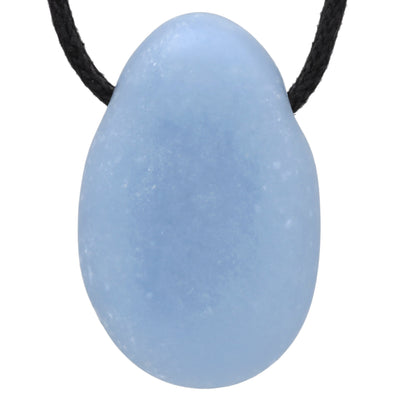
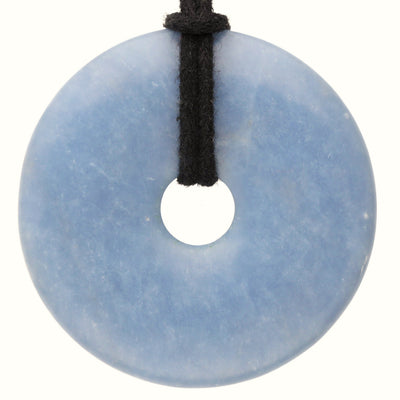
In our Angelite range ↗, you’ll find pendants and donuts made from genuine natural quality — ready to ship from Waldbröl or directly on site in our store in Nümbrecht.
Important note: The effects described here come from traditional crystal healing and are not scientifically proven. They do not replace medical diagnosis or treatment. If you have health concerns, please consult a doctor.
Further gemstone guides
- Larimar effect — the stone of calm & communication
- Chalcedony effect — meaning, use & care
- Clean and charge gemstones — the easy way
- Amethyst effect — meaning, use & cleansing
- Rose Quartz effect — meaning, use & cleansing
- View all Angelite products