


The Obsidian is the uncompromising stone of protection and truth — deep black volcanic glass, formed in seconds from glowing lava. In crystal healing, it is considered a powerful mirror: it is said to make repressed issues visible, ground, and protect. An intense stone, not a gentle one. In this guide, you’ll find everything about the purported effects of Obsidian on the psyche, body, and chakras, plus application, care, and the most common questions from our store in Nümbrecht.
Obsidian — quick profile at a glance
| Mineral class | Volcanic rock glass (amorphous, not a crystal) |
| Color | deep black; also snowflake, mahogany, rainbow obsidian |
| Hardness (Mohs) | 5 to 5.5 out of 10 |
| Structure | amorphous (solidified lava, no crystal structure) |
| Chakra | Root chakra |
| Zodiac sign | Scorpio (main), Sagittarius, Capricorn |
| Element | Fire / Earth |
| Suitable for gemstone water | ⚠️ Not recommended — sharp fracture edges, glass structure |
| Sunlight | Yes ✓ — does not fade |
| Main locations | Mexico, USA, Iceland, Lipari (Italy), Armenia |
What is Obsidian? Mineralogy and origin
Obsidian is not a mineral in the classic sense — it is natural volcanic glass. When thin, silica-rich lava cools so quickly that no crystals can form, it solidifies into a glassy, amorphous material. Obsidian therefore forms in seconds, while other gemstones take millions of years — energetically, that makes it a “fast,” direct stone.
The name goes back to the Roman Obsius, who, according to Pliny the Elder, brought the stone from Ethiopia to Rome. There are numerous varieties: snowflake obsidian (with gray cristobalite spots), mahogany obsidian (reddish-brown striped), rainbow obsidian (with an iridescent sheen), and the Apache tear (small, round, translucent nodules).
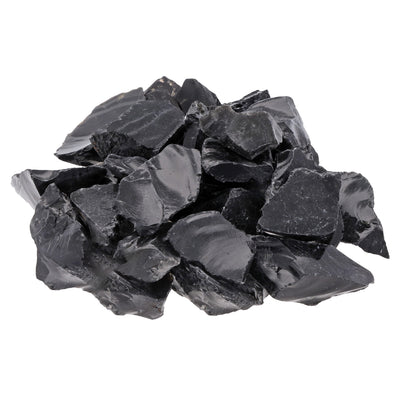
With a Mohs hardness of 5–5.5, Obsidian is relatively soft, but it breaks with razor-sharp edges — as early as the Stone Age, blades and arrowheads were made from it. Main sources are volcanic regions: Mexico, the USA, Iceland, and the Lipari Islands.
Meaning & history: The mirror of the soul
Obsidian is deeply rooted in human history. The Aztecs and Maya revered it as a sacred stone — they made sacrificial knives, mirrors, and the mask of the god Tezcatlipoca, whose name means “smoking mirror.” Aztec seers used polished obsidian mirrors for visions.
In Europe, Obsidian was already a sought-after trade good in the Stone Age. The famous Renaissance magician John Dee used an Aztec obsidian mirror for his séances — it is now in the British Museum.
In modern crystal healing, Obsidian is considered the stone of uncompromising truth and protection. It is described as a “mirror of the soul” — a stone that brings repressed issues to light. That is why it is considered powerful, but not for a delicate phase.
Purported effects of Obsidian on the psyche
Obsidian is an intense stone — we always say that in the shop. In crystal healing, the following effects are attributed to it:
- Protection & shielding: Considered one of the strongest protection stones — said to ward off negative energies, external influences, and “energy vampires.”
- Grounding: Said to ground quickly and powerfully when you feel “ungrounded” or overstimulated.
- Shadow work: The “mirror of the soul” — said to make repressed, denied, and blind-spot issues visible. A powerful aid when therapeutically accompanied, but a challenge on your own.
- Truth & clarity: Said to dissolve illusions and self-deception — uncompromisingly honest.
- Letting go of old patterns: Used to recognize and release entrenched behavior patterns and old wounds.
- Trauma support: Traditionally used in crystal healing — but explicitly recommended only with professional support.
Important from our practice: Obsidian is not a stone for “constant wearing.” It is used selectively — in stable phases, for clear work on a specific issue. In acute crises, a gentle stone (rose quartz, moonstone) is often the better choice.
Purported effects of Obsidian on the body
In traditional crystal healing, the following physical effects are attributed to Obsidian — these claims come from traditional descriptions and are not a substitute for medical diagnosis or treatment.
- Circulation: Associated with a stimulating effect on the circulation.
- Tension: Traditionally used when placed on muscle tension and blockages.
- Stomach & digestion: Traditionally used for digestive complaints.
- Pain: Said to have supportive effects when placed on acute pain.
- Wound healing: Described in folk healing for scars and slow healing.
Obsidian is almost always used worn on the body or placed on the body, not as gemstone water. View Obsidian tumbled stones and jewelry ↗

Obsidian and the root chakra
In chakra teachings, Obsidian is clearly assigned to the root chakra (Muladhara) — the energy center at the pelvic floor, which stands for safety, grounding, primal trust, and connection to the material world. Its deep black color is considered the color of protection and grounding.
In practice, Obsidian is therefore often placed at the feet or on the tailbone — it is said to help you “ground” when life pulls the ground out from under your feet. It is also used as a tumbled stone in both hands during a grounding meditation.
Obsidian & the 7 main chakras
Obsidian is clearly a root chakra stone — it is said to strengthen safety, grounding, and protection on the lowest, most physical energy level.
Obsidian and the zodiac signs
Astrologically, Obsidian is the main stone for Scorpio — the sign of depth, transformation, and uncompromising truth. Scorpio and Obsidian share the same quality: no sugarcoating, going deep.
It is a secondary stone for Sagittarius (search for truth) and Capricorn (grounding, realism). Obsidian is not a universal “fits everyone” stone — it is used specifically for protection and transformation themes, regardless of zodiac sign.
Using Obsidian in everyday life
1. As a protection stone in your pocket
An Obsidian tumbled stone in your trouser pocket is considered a personal shield — popular with people who work a lot with others (care, counseling, sales) and feel “empty” in the evening.
2. For grounding — placed at the feet
Lie down and place one Obsidian stone on each sole or on the tailbone. Said to ground quickly when you feel “ungrounded,” overstimulated, or dissociated. 10–15 minutes are enough.
3. In shadow work — with care
For conscious inner work: hold Obsidian in your hand during journaling, meditation, or therapeutic support. It is said to make repressed material accessible. Only in stable phases — not in acute crises.
4. As an Obsidian mirror or sphere in the room
A polished Obsidian sphere on the desk or in a room is traditionally considered energetic protection — and at the same time a beautiful, deep black object.
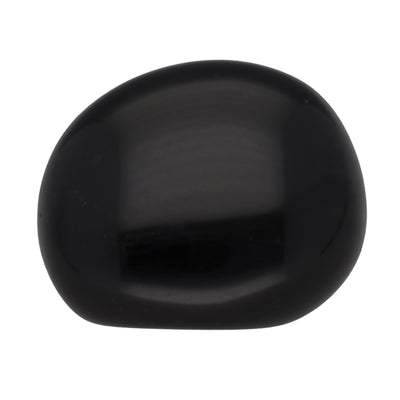
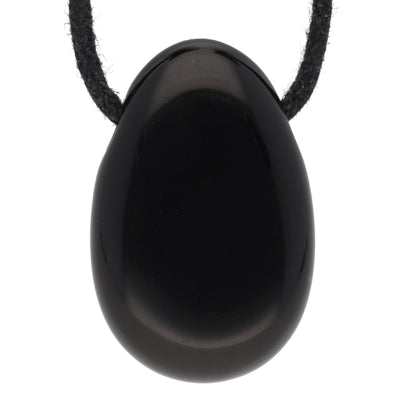
Obsidian, black bei Lebensquelle Plus
Echte Naturqualität — versandfertig aus Waldbröl, geprüfter Fachhandel.
![[slot:MAIN] MAIN polished](http://solunaspring.com/cdn/shop/files/MAIN_polished_ba47e792-01c9-4690-9292-f9471c3af7fa.jpg?v=1782815637&width=400)
Cleaning and charging Obsidian
Obsidian is a very absorbent protection stone — precisely because it shields, it fills up quickly. Frequent cleansing is essential.
Discharging
- Briefly rinse under running lukewarm water — Obsidian can handle this, but not for too long (glass structure).
- In hematite tumbled stones overnight — very thorough, ideal for a “full” protection stone.
- Smudging with sage.
Charging
- On hematite tumbled stones or a rock crystal cluster — the gentle method recommended by the reference guide.
- Moonlight (full moon) — the classic gentle method.
- Sunlight is no problem for Obsidian (it does not fade) — as an alternative.
Please do not: use salt (it can damage the polished surface). And: really clean Obsidian often — more often than most other stones.
Clean & charge Obsidian
Two steps, one ritual — and with the protection stone Obsidian, the rule is: clean especially often.
Discharge
Briefly rinse under water (not too long — glass structure) or place on hematite overnight.
Tip: Clean Obsidian more often than other stones — as a protection stone, it absorbs a lot.
Charge
On hematite or a rock crystal cluster overnight — the reference recommendation. Or in moonlight.
Sun is also fine for Obsidian (it does not fade) — if you want.
⚠️ No salt — it damages the polished surface. Obsidian is relatively soft with Mohs 5–5.5.
Recognizing authenticity: Obsidian or black glass?
Because Obsidian itself is a natural glass, confusion with industrial glass is especially tricky:
- Industrial glass: Too perfect, too uniform, often with air bubbles. Real Obsidian has irregular streaks, occasionally tiny cristobalite inclusions.
- Conchoidal fracture: Real Obsidian breaks in a “shell-like” way (concave and glossy). A chipped edge on natural obsidian looks different from colored glass.
- Rainbow/gloss obsidian: The iridescence in genuine material is subtle and angle-dependent — brightly multicolored “obsidians” are often dyed glass.
At Lebensquelle Plus, Obsidian comes from verified natural volcanic deposits in Mexico.
Combining Obsidian with other stones
- Obsidian + rock crystal — rock crystal amplifies and “clarifies” the intense Obsidian energy.
- Obsidian + rose quartz — the most important combo: Obsidian shows things uncompromisingly, rose quartz catches them gently. Almost essential in shadow work.
- Obsidian + hematite — double grounding and protection, very “down to earth.”
- Obsidian + amethyst — protection below, clarity above. A good meditation combination.
Frequently asked questions about the effects of Obsidian
What effect does Obsidian have on the psyche?
In crystal healing, Obsidian is said to protect powerfully, ground, and make repressed issues visible (shadow work). It is considered a “mirror of the soul” — an intense, uncompromisingly honest stone. These effects are not scientifically proven.
Which chakra is Obsidian assigned to?
Obsidian is clearly a root chakra stone (Muladhara) — it is said to strengthen safety, grounding, primal trust, and protection on the most physical energy level.
Which zodiac sign is Obsidian for?
Obsidian is the main stone for Scorpio and a secondary stone for Sagittarius and Capricorn. It is not a universal stone — it is used specifically for protection and transformation themes.
Is Obsidian a “too strong” stone?
Obsidian is considered an intense stone. From our practice: it is not suitable for constant wearing or for acute crises — but for focused work on a specific issue, in stable phases. In sensitive times, gentle stones like rose quartz or moonstone are the better choice.
How do you properly cleanse Obsidian?
Briefly rinse under running water or discharge on hematite overnight. Charge on hematite, a rock crystal cluster, or in moonlight (reference recommendation); Obsidian also tolerates sun. No salt. Obsidian should be cleansed more often than most other stones.
Can Obsidian go in water?
Yes, briefly for rinsing — Obsidian can handle that. Longer water baths or gemstone water are not recommended, however: Obsidian is natural glass with sharp fracture edges, which makes it unsuitable for drinking water.
What is the difference between Obsidian and smoky quartz?
Both look dark and grounding, but are mineralogically different: Obsidian is amorphous volcanic glass (fast, direct, uncompromising), while smoky quartz is crystalline quartz (gentler, slower in effect). Smoky quartz is considered the milder grounding alternative.
What are snowflake and mahogany obsidian?
Varieties of Obsidian: snowflake obsidian has gray cristobalite spots (considered gentler, balancing), mahogany obsidian is reddish-brown striped (considered warmer, less uncompromising). Both are somewhat “milder” than pure black Obsidian.
How can I tell if my Obsidian is real?
Real Obsidian has irregular streaks, sometimes tiny inclusions, and breaks with a shell-like glossy fracture. Industrial glass is too perfect, often with round air bubbles. Brightly multicolored iridescent “obsidians” are often dyed glass.
Is Obsidian suitable as a gift?
With care: Obsidian is an intense stone and not suitable for everyone. As a gift, it is appropriate for people who consciously work on themselves — less so as a spontaneous token. When in doubt, a gentler stone is the safer choice.
Conclusion: Obsidian — the uncompromising protection stone
Obsidian is the powerful stone for protection, grounding, and truth. Not a gentle companion, but a targeted tool for conscious work. Anyone seeking protection, grounding, or honest self-confrontation and who is in a stable phase will find a reliable, direct ally in Obsidian.
In our Obsidian range ↗ you’ll find tumbled stones, spheres, jewelry, and special pieces made from volcanic natural quality — ready to ship from Waldbröl or directly on site in our store in Nümbrecht.
Important note: The effects described here come from traditional crystal healing and are not scientifically proven. They do not replace medical or psychotherapeutic diagnosis or treatment. If you have emotional or health concerns, please consult a doctor or therapist.
Further gemstone guides
- Rock crystal effects — meaning, application & cleansing
- Rose quartz effects — the gentle counterpart
- Tiger's eye effects — courage & protection
- Cleaning and charging gemstones — the easy way
- View all Obsidian products
