



Chrysocolla shines in the colors of a tropical sea — turquoise blue to green, often with mysterious patterns. In crystal healing, this copper-bearing mineral is considered the stone of calm communication, serenity, and feminine power. In this guide, you’ll find everything about the purported effects of Chrysocolla, its meaning, uses, proper (careful!) care, and an authenticity check — compiled by a specialist retailer.
Chrysocolla — quick facts at a glance
| Mineral class | Silicate — copper-bearing mineral |
| Color | turquoise blue, blue-green, green, often veined with brown matrix |
| Hardness (Mohs) | 2 to 4 — soft & delicate |
| Crystal system | usually amorphous / microcrystalline |
| Chakra | Throat chakra & heart chakra |
| Zodiac signs | Taurus, Gemini, Libra |
| Element | Water |
| Special feature | often mistaken for turquoise because of its color |
| Suitable for gemstone water | Not suitable — soft, porous, copper-bearing |
| Sunlight | Tolerates brief light — protect from prolonged sun |
| Main sources | Peru, USA (Arizona), Congo, Israel, Chile |
What is Chrysocolla? Mineralogy and origin
Chrysocolla is a copper-bearing silicate mineral that forms wherever copper ores weather — its intense turquoise-green colors are due precisely to this copper content. The name comes from Greek (chrysos = gold, kolla = glue), because the mineral was once used in gold soldering.
With a Mohs hardness of only 2 to 4, Chrysocolla is very soft and delicate. It is often intergrown with other copper minerals such as malachite, azurite, or turquoise and can be interspersed with quartz, which makes it somewhat harder and more stable (so-called “Chrysocolla quartz”).
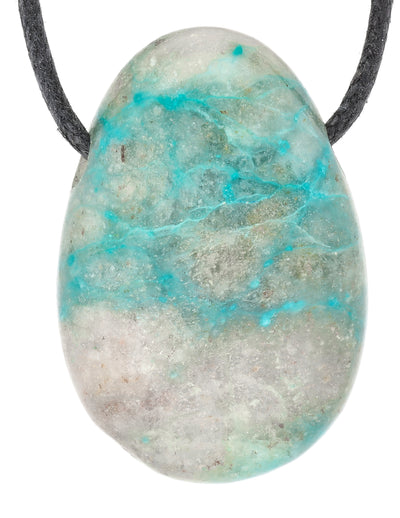
Because of its color, Chrysocolla is often mistaken for turquoise in trade or sold as such. However, genuine Chrysocolla shows typical flowing, veined patterns in blue and green, often with brown or black matrix inclusions. Main sources are Peru, Arizona (USA), and Congo.
Meaning & history
Chrysocolla has been known since antiquity — the bright mineral was already valued in ancient Egypt and by the Greeks. Tradition says that the famous Cleopatra is said to have carried a Chrysocolla stone with her in order to remain calm and diplomatic in negotiations.
In many cultures, Chrysocolla was regarded as the stone of wise, calm communication — associated with feminine power, diplomacy, and warmth. Native American traditions attributed calming, strengthening properties to it.
In modern crystal healing, Chrysocolla is the stone for anyone who wants to communicate calmly and warmly — a gentle bridge between the throat and heart chakras.
Purported effect of Chrysocolla on the psyche
If someone asks us for a stone for more serenity in conversations, against inner restlessness, or to strengthen the feminine side, Chrysocolla is a lovely recommendation. In crystal healing, it is said to have the following effects:
- Calm communication: The classic — Chrysocolla is said to help you speak calmly, warmly, and diplomatically instead of reacting impulsively.
- Serenity & inner peace: Said to gently smooth nervousness, tension, and emotional waves.
- Feminine power: Traditionally associated with feminine energy, intuition, and self-expression.
- Emotional balance: Associated with balancing mood swings and greater inner stability.
- Self-expression with heart: Said to help express one’s own truth lovingly and without fear.
- Releasing guilt: Traditionally a stone for letting go of old feelings of guilt and tension.
Chrysocolla is therefore especially suitable for phases in which calm communication, emotional balance, feminine power, or heartfelt self-expression are important — and for people who often react impulsively or find it hard to put their feelings into words.
Purported effect of Chrysocolla on the body
In traditional crystal healing, Chrysocolla is attributed the following physical effects — these statements come from traditional descriptions and are not a substitute for medical diagnosis or treatment.
- Throat & voice: As a throat chakra stone, traditionally assigned to the throat and voice area.
- Female organs: In folk healing, attributed to women’s health and the cycle.
- Nervous system: Associated with a calming effect during tension.
- Digestion: Traditionally associated with relaxing “gut feelings.”
- Thyroid: As a throat chakra stone, traditionally assigned to the throat area.
- General relaxation: Considered a cooling, calming companion during stress.
Chrysocolla is not suitable for gemstone water — it is soft, porous, and copper-bearing. Instead, wear it as a polished stone, pendant, or tumbled stone close to you, where its calming effect is most appreciated in crystal healing.

Chrysocolla and the chakras
In chakra teachings, Chrysocolla is primarily assigned to the throat chakra (Vishuddha) and the heart chakra (Anahata) — a rare, beautiful bridge between communication and the heart. That is exactly what defines its quality: heartfelt, calm, honest communication.
In practice, Chrysocolla is placed on the throat or chest or worn as a pendant. There, it is said to help express feelings lovingly and communicate calmly — without the typical fear of saying something wrong.
Some sources additionally assign Chrysocolla to the sacral chakra — as a stone of feminine, creative energy.
Chrysocolla & the 7 main chakras
Chrysocolla connects the throat and heart chakras — it is said to promote heartfelt, calm, and honest communication.
Chrysocolla and the zodiac signs
Astrologically, Chrysocolla is primarily assigned to Taurus (calm, stability, enjoyment) and Libra (harmony, balance). It is said to help these signs remain calm and diplomatic.
As a secondary stone, it is for Gemini (communication). As a gentle stone of calm communication, however, Chrysocolla suits anyone who wants to speak more warmly and calmly — especially people in communicative or social professions.
Using Chrysocolla in everyday life
1. As a pendant — for heartfelt communication
A Chrysocolla pendant at throat or heart level is the classic use. It is said to help you speak calmly, warmly, and honestly.
2. In the hand — before important conversations
Holding a Chrysocolla in your hand or putting it in your pocket before a difficult conversation — it is said to calm you and encourage diplomacy.
3. In meditation — for emotional balance
Placed on the chest, Chrysocolla is said to smooth emotional waves and bring inner peace.
4. In the living or working space
A beautiful polished Chrysocolla as a calming accent — said to create a serene, harmonious atmosphere.
5. As a companion for women
Traditionally a stone of feminine power — often worn to strengthen intuition and self-expression.
Chrysocolla bei Lebensquelle Plus
Echte Naturqualität — versandfertig aus Waldbröl, geprüfter Fachhandel.



Clean and recharge Chrysocolla
Clean & recharge Chrysocolla
Chrysocolla is very soft and delicate — it needs careful care.
Clean
Only wipe briefly with lukewarm water and a soft cloth — or cleanse gently with smoke. No salt water, no ultrasound, no acids. Do not soak in water for long periods (porous).
Gentle alternative: smudging with sage or a short placement on hematite.
Recharge
Recharge in moonlight — the gentlest method for this soft stone.
Alternative: place briefly on an amethyst cluster.
⚠️ Very soft (hardness 2–4) & porous! No salt water, no ultrasound, no acids, no long water bath. Not suitable for gemstone water (copper-bearing).
Recognizing authenticity
Chrysocolla is often mistaken for turquoise or imitated with dyed material. These features help:
- Pattern: genuine Chrysocolla shows flowing, veined patterns in blue and green, often with brown or black matrix — very uniform, single-color pieces are suspicious.
- Distinguishing from turquoise: Turquoise is usually more uniform and somewhat harder; Chrysocolla is softer and often greener with flowing transitions.
- Hardness: pure Chrysocolla is very soft (2–4) and can be scratched easily. Chrysocolla interspersed with quartz is harder.
- Dyed material: strikingly bright, uniform color without natural veining suggests dyed howlite or magnesite.
- Feel: genuine Chrysocolla feels cool and naturally irregular; plastic imitations feel warm and too uniform.
Genuine Chrysocolla shows flowing turquoise-green patterns, is soft, and naturally irregular. At Lebensquelle Plus, Chrysocolla comes from verified natural quality — no dyed imitation.
Combining Chrysocolla with other stones
- Chrysocolla + Rose Quartz — gentle heart opening plus calm communication — a loving combination.
- Chrysocolla + Aquamarine — double throat chakra power for clear, calm words.
- Chrysocolla + Amethyst — serenity meets calm — good for emotional balance.
- Chrysocolla + Malachite — both copper-bearing — transformation and heartfelt communication (neither in water!).
- Chrysocolla + Moonstone — feminine power & intuition — a gentle women’s combination.
Frequently asked questions about the effects of Chrysocolla
01 What does Chrysocolla do? +
In crystal healing, Chrysocolla is considered a stone of calm communication, serenity, and feminine power. It is said to help you speak warmly and diplomatically, smooth emotional waves, and strengthen the feminine, intuitive side — a bridge between the throat and heart chakras.
02 Is Chrysocolla the same as turquoise? +
No, but they are often confused. Both are copper-bearing and turquoise-colored, but Chrysocolla is softer and shows flowing, veined blue-green patterns, while turquoise is usually more uniform and harder. In trade, Chrysocolla is sometimes incorrectly sold as turquoise.
03 Can Chrysocolla go in water? +
No, better not. Chrysocolla is very soft (hardness 2–4), porous, and copper-bearing. Prolonged contact with water damages it, and it is not suitable for gemstone water. To clean it, only wipe briefly with lukewarm water and a soft cloth or cleanse with smoke.
04 How do I care for Chrysocolla properly? +
Clean: only briefly with lukewarm water and a soft cloth or gently with smoke — no salt water, no ultrasound, no acids. Recharge: in moonlight. Protect from prolonged sun and impacts. Full guide: Clean and recharge gemstones.
05 Which zodiac sign is Chrysocolla for? +
Chrysocolla is primarily assigned to Taurus and Libra, and as a secondary stone to Gemini. As a stone of calm communication, however, it suits anyone who wants to speak more warmly and calmly.
06 Is Chrysocolla toxic? +
Chrysocolla is copper-bearing. It is safe to wear as jewelry. However, it should not be used for gemstone water, and you should wash your hands after handling it before eating — as a precaution, this applies to all copper-bearing stones.
07 Which stones go well with Chrysocolla? +
Classic combinations: Chrysocolla + Rose Quartz (heart & communication), Chrysocolla + Aquamarine (clear words), Chrysocolla + Amethyst (emotional balance), Chrysocolla + Moonstone (feminine power).
08 Is Chrysocolla suitable as a gift? +
Very much so — Chrysocolla is a meaningful gift for people you wish serenity, heartfelt communication, and feminine power. Its bright turquoise-green colors also make it a striking, individual jewelry stone.
Conclusion
Chrysocolla — the turquoise-green stone of calm communication. Copper-bearing, soft, and in the colors of a tropical sea. In crystal healing, a gentle bridge between throat and heart, for anyone who wants to speak more calmly and warmly. A stone of feminine power and emotional balance.
In our Chrysocolla range ↗ you’ll find polished stones, pendants, and tumbled stones in genuine natural quality — ready to ship from Waldbröl or available directly on site in our store in Nümbrecht.
Important note: The effects described here come from traditional crystal healing and are not scientifically proven. They do not replace medical diagnosis or treatment. If you have health concerns, please consult a doctor.
Further gemstone guides
- Clear Quartz effect — meaning, use & cleansing
- Amethyst effect — meaning, use & cleansing
- Clean and recharge gemstones — the easy way
- Rose Quartz effect — the heart stone
- Aquamarine effect — clarity & communication
- View all Chrysocolla products
