


Rhodonite — glowing pink-red, streaked with distinctive black veins. In crystal healing, it is regarded as the stone of emotional healing, forgiveness, and the heart and is traditionally described as a “first-aid stone” for the soul. In this guide, you’ll find everything about the supposed effects of rhodonite, its meaning, uses, proper care, and an authenticity check — concise, honest, and compiled by a specialist retailer.
Rhodonite — quick profile at a glance
| Mineral class | Silicate — manganese silicate (inosilicate) |
| Color | pink to raspberry red, with characteristic black manganese veins |
| Hardness (Mohs) | 5.5 to 6.5 — sturdy, but not indestructible |
| Crystal system | triclinic |
| Chakra | Heart chakra (Anahata) |
| Zodiac sign | Taurus (main), Cancer |
| Element | Earth |
| Special feature | often confused with rhodochrosite — rhodonite has black veins |
| Suitable for gemstone water | Conditionally suitable — sturdy (hardness 6), polished stones, only briefly |
| Sunlight | Handles light well — no special sensitivity |
| Main sources | Russia (Ural), Sweden, Australia, Brazil, Madagascar |
What is rhodonite? Mineralogy and origin
Rhodonite is a manganese silicate and owes its pink to raspberry-red color precisely to this manganese content. Its name comes from the Greek rhodon — “rose.” With a Mohs hardness of 5.5 to 6.5, it is a sturdy, wearable stone, but it can be sensitive to hard impacts.
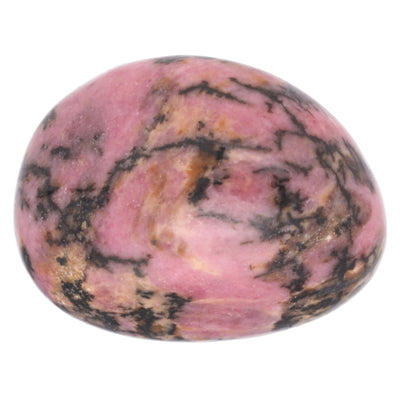
The unmistakable identifying feature is the black veins and dendrites of manganese oxide that run through the pink material in a net-like pattern. This black marbling is exactly what distinguishes rhodonite from its often-confused relative, the purely pink-banded rhodochrosite.
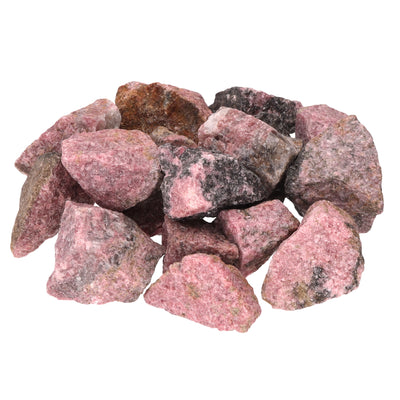
The most famous deposits are in the Russian Ural Mountains, where rhodonite was processed in the tsarist empire for ceremonial halls, vases, and jewelry. Other sources include Sweden, Australia, Brazil, and Madagascar.
Meaning & history
In the Ural, rhodonite was a national stone — the Russian tsars had entire halls and precious objects made from it. According to legend, travelers were given rhodonite to carry in their pockets because its pink glow was considered a warning and protective sign; there it was also called the “eagle stone.”
In many traditions, rhodonite is regarded as the stone of love, reconciliation, and inner balance — a companion said to help one find their way back to the heart after conflict or emotional pain.
In modern crystal healing, rhodonite is the classic “first-aid stone” for the soul — it is said to provide support and comfort in acute emotional crises, after shock, separation, or grief.
Supposed effects of rhodonite on the psyche
When someone asks us for a stone for a wounded heart, for forgiveness, or against emotional pain, the name rhodonite comes up quickly. In crystal healing, it is said to have the following effects:
- Emotional healing: The classic — rhodonite is said to gently help heal emotional wounds, old pain, and trauma.
- Forgiveness & reconciliation: Said to help forgive — oneself and others — and let go of old resentment.
- Emotional balance: Associated with balancing mood swings and greater inner stability.
- Calm in crises: As a “first-aid stone,” it is said to soothe and provide support after shock, conflict, or separation.
- Self-love & self-worth: Said to open the heart to oneself and strengthen self-acceptance.
- Transforming anger into love: Traditionally described as a stone that transforms pent-up anger and jealousy into serenity.
Rhodonite is therefore especially suited to phases in which emotional healing, forgiveness, emotional balance, or comfort after a crisis are the focus — and to people who want to reopen a wounded heart.
Supposed effects of rhodonite on the body
In traditional crystal healing, the following physical effects are attributed to rhodonite — these claims come from historical descriptions and are not a substitute for medical diagnosis or treatment.
- Heart & circulation: Traditionally assigned to the heart area as a heart chakra stone.
- Wound healing: In folk healing, passed down as a stone said to support the healing of minor wounds.
- Stress-related complaints: Associated with releasing tension and stress-related restlessness.
- Immune forces: In old descriptions, attributed to general self-healing powers.
- Skin: Traditionally linked to a healthy, vital complexion.
- General well-being: Considered a balancing, heart-strengthening companion in everyday life.
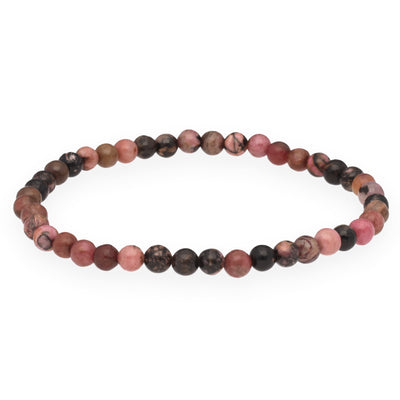
With a hardness of 5.5–6.5, rhodonite is relatively sturdy and conditionally suitable for brief gemstone water use — ideally use polished, smooth stones and do not leave them in water overnight. It is more beautiful and practical for everyday wear as a pendant, tumbled stone, or bracelet worn close to the heart.

Rhodonite and the chakras
In chakra teachings, rhodonite is clearly assigned to the heart chakra (Anahata) — the energy center in the middle of the chest that stands for love, compassion, forgiveness, and emotional balance. Its pink-red color is the classic color of heart energy.
In practice, rhodonite is placed on the chest during meditation or worn as a pendant at heart level. It is said to heal emotional wounds there, open the heart to forgiveness, and provide support after emotional crises.
The black manganese marbling gives the stone an additional grounding, stabilizing note — it is said to open the heart without losing your footing.
Rhodonite & the 7 main chakras
Rhodonite is a classic heart chakra stone — it is said to heal emotional wounds, open the heart to forgiveness, and bring emotional balance.
Rhodonite and the zodiac signs
Astrologically, rhodonite is considered the main stone for Taurus — the warm-hearted, steady earth sign. It is said to help Taurus forgive in relationships and maintain emotional stability.
It is a secondary stone for Cancer (feeling, security). As a stone of emotional healing, however, rhodonite suits every zodiac sign, especially people who want to heal a wounded heart or forgive.
Using rhodonite in everyday life
1. As jewelry close to the heart — the emotional companion
A rhodonite pendant worn at heart level is the classic use. Worn directly, it is said to balance emotions and provide comfort in difficult times.
2. In the hand — in acute crises
Hold rhodonite firmly in your hand when emotions are running high — as a “first-aid stone,” it is said to calm and provide support.
3. In meditation — for forgiveness
Placed on the chest, rhodonite is said to open the heart, release old resentment, and help with forgiveness.
4. Under the pillow — for processing
Traditionally used to sleep more peacefully after stressful experiences and to process emotions.
5. As a companion in relationships
A rhodonite for both partners — said to promote reconciliation, mutual understanding, and warmth.
Rhodonite bei Lebensquelle Plus
Echte Naturqualität — versandfertig aus Waldbröl, geprüfter Fachhandel.
![[slot:MAIN] MAIN polished](http://solunaspring.com/cdn/shop/files/SQUARE_new_a5d670b7-095e-463e-b87c-8ff5ac572d0a.jpg?v=1782976813&width=400)
Cleaning and charging rhodonite
Clean & charge rhodonite
Rhodonite is sturdy (hardness 5.5–6.5) and easy to care for.
Discharge
Rinse under running lukewarm water and dry — rhodonite tolerates water well.
Alternatively, discharge overnight in a bowl with hematite tumbled stones.
Charge
Charge in moonlight or on a clear quartz cluster / amethyst geode.
A clear quartz cluster keeps rhodonite fresh long-term.
⚠️ Avoid acids and harsh cleaners. Hardness 5.5–6.5 means moderate sensitivity — protect jewelry from hard impacts.
Recognizing authenticity
Rhodonite is most often confused with rhodochrosite and occasionally imitated with dyed material. These features help:
- Black veins: genuine rhodonite almost always shows characteristic black manganese oxide veins or dendrites in the pink material — this is its most important authenticity feature.
- Distinction from rhodochrosite: rhodochrosite is pink-white banded (striped), softer, and without black veins. Rhodonite is a stronger red with a black network.
- Hardness: at 5.5–6.5, rhodonite does not scratch glass as easily as quartz, but it can hardly be scratched with a knife — very soft material is suspicious (dyed howlite).
- Color: natural pink-red looks warm and slightly uneven; an overly bright, uniform, kitschy color without any marbling suggests a dyed imitation.
- Feel: genuine rhodonite feels cool and substantial, while plastic imitations feel warm and too light.
Genuine rhodonite is pink-red with typical black veins, cool, and sturdy. At Lebensquelle Plus, rhodonite comes from verified natural quality — no dyed imitation.
Combining rhodonite with other stones
- Rhodonite + rose quartz — double heart power — healing old wounds meets gentle self-love.
- Rhodonite + clear quartz — clear quartz clarifies and amplifies the emotionally healing effect.
- Rhodonite + rhodochrosite — both heart stones — a gentle combination for emotional healing and joy of life.
- Rhodonite + amethyst — emotional healing with calm — good for processing and letting go.
- Rhodonite + black tourmaline — heart opening with grounding & protection — support in emotionally difficult phases.
Frequently asked questions about the effects of rhodonite
01 What does rhodonite do? +
In crystal healing, rhodonite is considered a stone of emotional healing, forgiveness, and the heart. It is said to heal emotional wounds, help with forgiveness, balance emotions, and provide comfort and support after shock, conflict, or separation as a 'first-aid stone.'
02 What is the difference between rhodonite and rhodochrosite? +
Rhodonite is a stronger pink-red and shows characteristic black manganese veins. Rhodochrosite is lighter pink-white banded (striped), softer, and has no black veins. Both are heart stones, but can be distinguished well by their marbling.
03 Which zodiac sign is rhodonite for? +
Rhodonite is mainly assigned to Taurus, the warm-hearted earth sign. It is a secondary stone for Cancer. As a stone of emotional healing, however, it suits anyone who wants to heal a wounded heart or forgive.
04 Can rhodonite go in water? +
Yes — rhodonite is sturdy with a hardness of 5.5–6.5 and can be cleaned under running water. For gemstone water, it is only conditionally suitable and only briefly (polished stones, not overnight). Avoid acids and harsh cleaners.
05 How do I care for rhodonite properly? +
Cleaning: rinse under running lukewarm water. Charging: in moonlight or on a clear quartz cluster or amethyst geode. Avoid: acids, harsh cleaners, and hard impacts. Complete guide: Clean and charge gemstones.
06 Why is rhodonite considered a first-aid stone? +
In crystal healing, rhodonite is said to quickly soothe and provide support in acute emotional crises — after shock, conflict, separation, or grief. That is why it is traditionally called a spiritual 'first-aid stone' and is often carried in a pocket.
07 How do I recognize genuine rhodonite? +
Genuine rhodonite is pink to raspberry red and almost always shows characteristic black manganese veins. It feels cool and substantial and is sturdy with a hardness of 5.5–6.5. An overly bright, uniform color without marbling or very soft material indicates a dyed imitation.
08 Which stones go well with rhodonite? +
Classic combinations: rhodonite + rose quartz (double heart power), rhodonite + clear quartz (clarity & amplification), rhodonite + rhodochrosite (emotional healing), rhodonite + amethyst (calm), rhodonite + black tourmaline (grounding & protection).
09 Is rhodonite suitable as a gift? +
Very much so — rhodonite is a loving, meaningful gift for people going through a difficult time, who need comfort, or to whom you wish reconciliation and warmth. As a pendant or tumbled stone, it is a beautiful emotional companion.
Conclusion
Rhodonite — the pink heart with a black vein. In crystal healing, the classic stone for emotional healing, forgiveness, and comfort in difficult times. Anyone who wants to open a wounded heart, forgive, or find support again after a crisis will find a warm, grounding companion in rhodonite.
In our rhodonite range ↗, you’ll find tumbled stones, pendants, and jewelry made from genuine natural quality — ready to ship from Waldbröl or directly on site in our store in Nümbrecht.
Important note: The effects described here come from traditional crystal healing and are not scientifically proven. They do not replace medical diagnosis or treatment. If you have health concerns, please consult a doctor.
Further gemstone guides
- Clear Quartz effect — meaning, use & cleansing
- Amethyst effect — meaning, use & cleansing
- Clean and charge gemstones — the easy way
- Rose Quartz effect — the heart stone
- Amethyst effect — king of calm
- View all rhodonite products
